 ×
×
Large-scale energy storage is one of the most demanding applications in modern power engineering. Whether the objective is grid frequency regulation, renewable energy time-shifting, industrial peak shaving, or microgrid resilience, the battery system at the core of the installation must deliver high capacity, reliable performance, safe operation, and cost-effective scalability. The high voltage battery system architecture has emerged as the dominant technical approach for meeting these requirements—and understanding why requires a detailed examination of the physics and engineering that make high voltage configurations superior at scale.
Power delivery from a battery bank is governed by the equation P = V × I. For a given power requirement, increasing voltage allows proportional reduction in current. In large-scale storage applications, where power requirements may reach hundreds of kilowatts or several megawatts, the current management implications of this relationship are enormous.
A low-voltage system delivering 500kW must handle currents measured in tens of thousands of amperes. Copper busbars at these current levels require enormous cross-sections, generate significant resistive heat, and demand sophisticated thermal management infrastructure. A high voltage system delivering the same 500kW at 500V DC requires only 1,000A—a manageable current level achievable with standard industrial cabling.
This current reduction does not just simplify installation—it directly reduces energy losses. Resistive losses scale with the square of current (P_loss = I² × R). Halving current reduces resistive losses by a factor of four. In a large storage installation operating across thousands of charge-discharge cycles over a 15–20 year service life, this efficiency differential compounds into enormous cumulative energy savings and correspondingly lower levelized cost of energy.
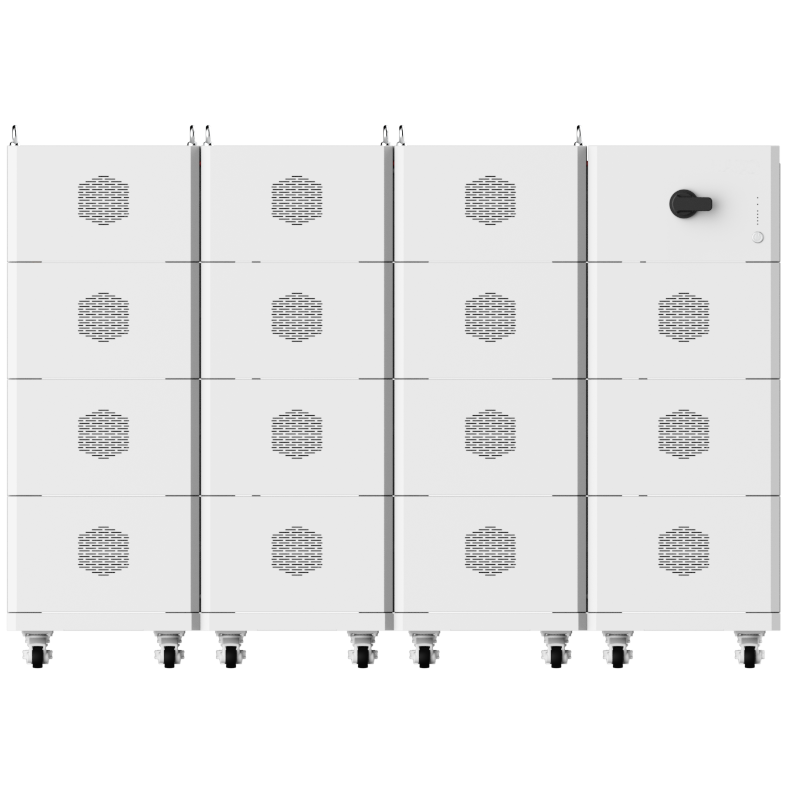
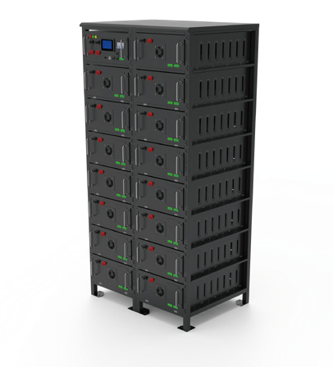
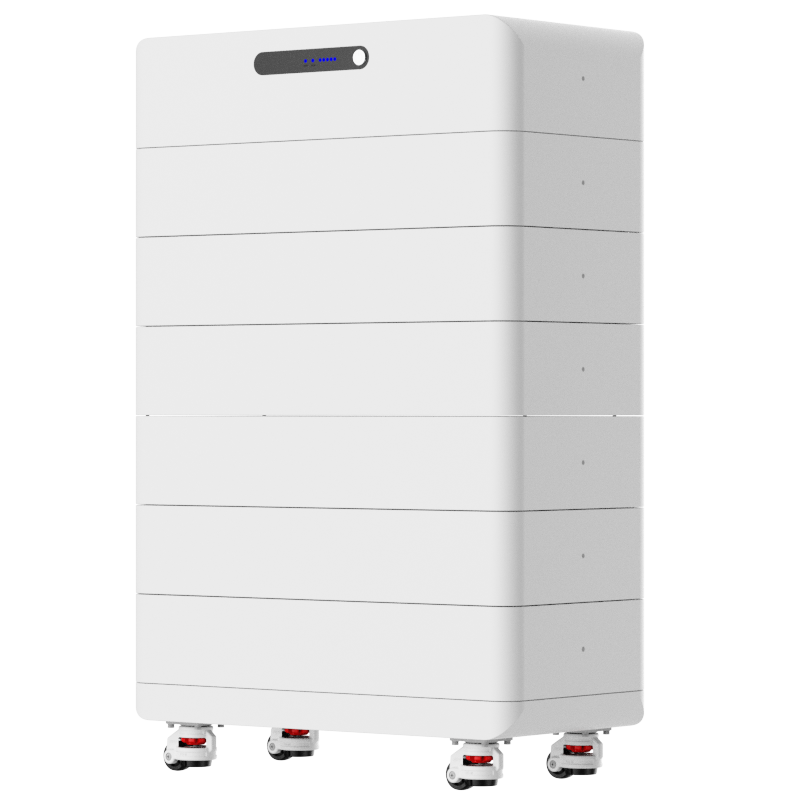
Helio's high voltage product line demonstrates how stackable modular architecture enables the same fundamental platform to serve applications across a wide scale range. The HN-HVS5 system stacks 2 to 6 modular 102.4V battery blocks in series, achieving system voltages from 204.8V to 614.4V. Five towers operating in parallel extend usable capacity to 153.6kWh—suitable for high-end residential and small commercial applications.
For industrial and large commercial scale, the HL605 system scales further: 2 to 19 modules of 51.2V each in series achieves system nominal voltages from 102V to 972V, with a base unit capacity of 51.2kWh per cabinet. Multiple cabinets can be combined to achieve project-level storage requirements in the hundreds of kilowatt-hours to multi-megawatt-hour range.
This modular approach to large-scale storage offers practical engineering advantages that monolithic battery installations cannot match. Individual modules can be tested independently before installation. Failed modules can be replaced without decommissioning the entire system. Capacity can be expanded by adding modules rather than replacing the entire installation. These characteristics significantly reduce both installation risk and long-term maintenance costs for large projects.
The battery management system becomes progressively more important—and more sophisticated—as installation scale increases. At the cell level, the BMS must maintain voltage balance across all cells in the series string. For a 19-module HL605 configuration operating at 972V, the string may contain hundreds of individual cells. Maintaining cell-level balance across this string is a continuous real-time computation that requires advanced balancing algorithms and precise voltage measurement hardware.
Beyond cell balancing, large-scale BMS installations must manage thermal gradients across physically distributed battery banks, coordinate communication with grid-connected inverters, implement demand response logic, and maintain comprehensive data logs for performance analysis and warranty compliance. Helio's BMS architecture, communicating via CAN and RS485 protocols, provides the data infrastructure for all of these functions.
The communication stack between BMS and inverter is particularly critical for large-scale applications. Real-time state-of-charge (SoC) reporting enables inverters to implement sophisticated charge management strategies—ramping charge and discharge rates to protect cycle life, coordinating battery dispatch with grid frequency signals, and scheduling maintenance cycles during low-demand periods.
Large-scale energy storage operates in environments and duty cycles that can stress battery systems significantly. Industrial facilities may expose battery installations to temperature extremes, high humidity, vibration, and continuous high-rate cycling demands. Helio's high voltage systems are engineered to operate within these conditions: the HN-HVS16 system, for example, supports discharge from -20°C to 55°C, while the HL605 commercial system operates within a charge range of 0°C to 55°C and discharge range of -20°C to 55°C.
The cycle life performance of LiFePO4 chemistry underpins the commercial case for large-scale investment. Helio's high voltage systems are rated for >6,000 cycles at 80% depth of discharge (DOD)—a specification that supports a 15–20 year operational lifespan at daily cycling rates. For utility-scale investors and industrial operators, this cycle life performance transforms battery storage from a capital expense requiring periodic replacement into a durable infrastructure asset with predictable performance over two decades.
Large-scale energy storage installations in industrial, commercial, and utility environments face stringent safety and certification requirements. Regulators, insurers, and grid operators require documented compliance with international safety standards before permitting grid connection or building permit approval.
Helio's certification portfolio—IEC62619, CE, UN38.3, UL1973, FCC—covers the major regulatory frameworks across European, North American, and global markets. For large-scale project developers managing multi-jurisdictional deployments, a single certified supplier that covers multiple regulatory frameworks significantly reduces compliance management complexity.
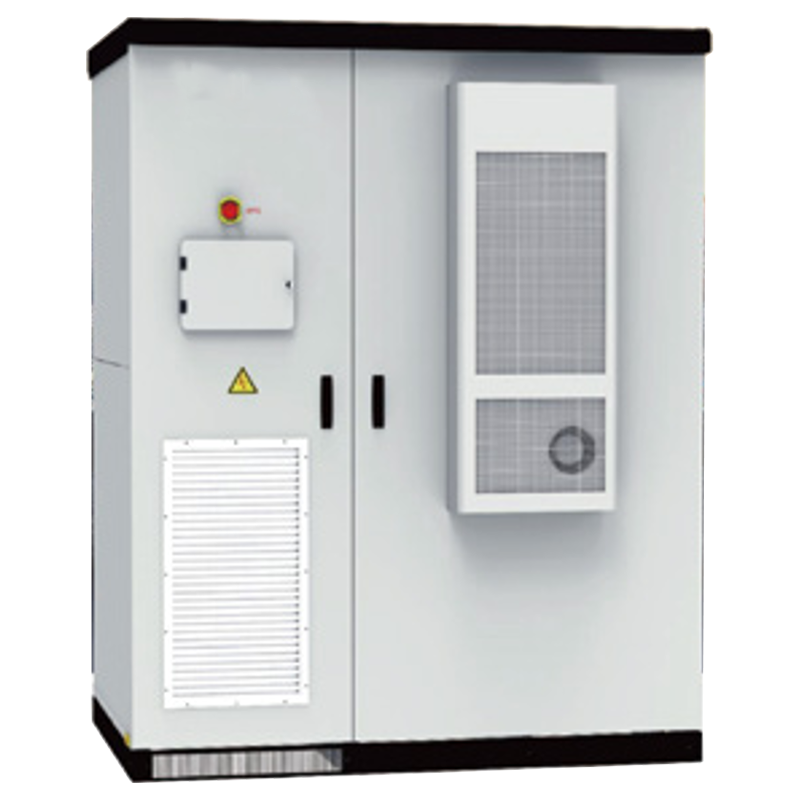
The IP20 protection rating of Helio's high voltage systems suits enclosed, conditioned installation environments—electrical rooms, battery enclosures, equipment rooms—that are standard in commercial and industrial energy storage deployments. For harsher outdoor environments, Helio's enclosure design accommodates additional environmental protection measures.
The financial case for high voltage battery systems in large-scale applications is compelling when properly calculated. Higher upfront system cost compared to equivalent low-voltage installations is offset by: reduced cabling material costs, lower installation labor costs, higher round-trip efficiency, longer cycle life at high cycling rates, and lower thermal management infrastructure requirements.
An economic model for a 500kWh commercial storage installation operating at daily cycling would show that the efficiency advantage of a high voltage architecture—typically 2–4 percentage points higher round-trip efficiency than equivalent low-voltage systems—generates meaningful annual energy savings over a 20-year project life. Combined with lower installation costs and maintenance savings, the total cost of ownership for a high voltage system is lower even when per-kWh capital cost is comparable.
High voltage battery systems support large-scale energy storage through a combination of fundamental physics advantages, modular scalability, sophisticated BMS performance, proven cycle life, and comprehensive certification coverage. Helio's high voltage product line, spanning from 10kWh residential applications to multi-hundred-kWh commercial and industrial installations, provides a technically and commercially mature platform for large-scale energy storage deployment. Explore Helio's large-scale storage solutions at Helioenergy.com.
 Hot News
2026-08-25
2026-08-18
2026-08-13
2026-08-08
2026-08-03
2026-06-28

 EN
EN